


 Sorting out Mayflies

by Karen Christopherson
I don't think that it's just me who gets confused by the assortment of mayflies out on the water, or mentioned in a flyshop. References to nicknames, scientific names, or flies can get one mighty confused as to what fly we should be using as a certain hatch is on. Adding to the confusion is that, when you actually see a hatch, and maybe two hatches, you ask, "which mayfly is that?". Of course you can always throw on a fly that matches the size and color, but I sometimes actually want to know which mayfly it is that's hatching.
Mayflies make up the order Ephemeroptera, which is from the Greek "Ephemera" for "short-lived" and "ptera" for "winged". This aptly describes the mayfly's adult life. After emerging as an adult, the mayfly lives from one hour to one day, during which time its sole purpose is to mate and lay the eggs. Prior to this, it has enjoyed almost one year as a nymph (if it could avoid those trout)!
 According to Ward and Kondratieff, 11 of the 17 known North American
mayfly families are represented in Colorado. This includes
33 Genera and 71 Species. There are something like 570
species in North America. Yikes! As a flyfisherman, do you
have to recognize 71 species of mayflies? Answer, "no", but
it will be useful to know a few of the Genera. Telling the
species apart is actually very difficult, especially when
those mayflies are flitting around and you have more
important things to do (like fish).
According to Ward and Kondratieff, 11 of the 17 known North American
mayfly families are represented in Colorado. This includes
33 Genera and 71 Species. There are something like 570
species in North America. Yikes! As a flyfisherman, do you
have to recognize 71 species of mayflies? Answer, "no", but
it will be useful to know a few of the Genera. Telling the
species apart is actually very difficult, especially when
those mayflies are flitting around and you have more
important things to do (like fish).
Life Cycle
The mayfly has three stage of insect life - egg, nymph and adult. It spends its life as an egg from an average of one to three months, then as a nymph for 8 to 11 months. When the adult emerges, it is first in a subimago stage (what we flyfisherpeople know as "dun") - it is winged but can't mate. Soon (like hours), the dun molts and becomes a true imago (translation "spinner"). The spinner mates, lays eggs, and dies. Falling on the water provides a welcome feast for trout.
Recognition
Nymph mayflies have various habitats in the water as either swimmers, crawlers, burrowers, or clingers. They are mostly brown or black and have 2 or 3 tails.
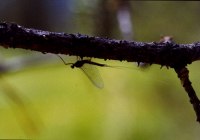
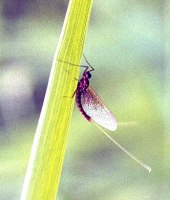
Adult Mayflies are very distinctive in that they have relatively large upright wings (for their body size) and long, extended, upturned tail (actually 2 or 3 tails). They have a method of flying where they seem to dart up and down in the air. The males will swarm, and the female flies into this swarm.
The following table attempts to summarize some basic information about the various mayflies found in Colorado and Wyoming. Given are the scientific name (which many people will use to identify a hatch), the common name (which many other people will use for a specific mayfly), where in Colorado or Wyoming they are found, good dry fly imitations, the nymph behavior, the colors of the adult (to help you in identification), the time of year that they hatch, and the typical size of the adult mayfly (given by hook size).
| Sci Name(Genus and species) | Common Name | State | Dry flies | Nymphs | Adult colors | Time of year | Size |
| Baetis vagans+ many others | BWO (Blue-winged olive) | CO+WY | BWO, Parachute Adams | swimmer | olive/brown belly; greyish wings | mar-nov | 16-24 |
| Ephemerella/Drunella guttulata + grandis+ coloradensis | Green Drake (western) | western CO+WY | green drake | crawler | grey-green, olive body; greyish wings | jul-sep | 10-12 |
| Ephemerella inermis (smaller) + infrequens (larger) | PMD (Pale Morning Dun) | CO+WY | PMD | crawler | greyish wings; body varies | jun-aug | 14-20 |
| Rhithrogena hageni+ robusta+ others | Red Quill | WY+CO (parts) | Red Quill | red/brown body; greyish wings | jun-oct | 12-18 | |
| Tricorythodes minutus+ stygiatus+ others | Trico | CO+WY | Tricos, Parachute Adams, Royal Wulff | crawler | olive, black, brownish body; clear or grey wings | jul-sep | 20-26 |
| Callibaetis americanus + many others | Callibaetis | CO+WY | Callibaetis, cahill, | swimmer | light veins on dark wings; greyish body | jul-aug | 14-16 |
| Ephemera simulans | Brown drake | nw WY+nw CO | clinger | lt/dark brown body: splotchy wing | may-oct | 8-12 | |
| Rhithrogena morrisoni | Western March Brown | western CO+WY | various Western March patterns | clinger | tan/brown body; mottled wing | mar-apr | 10-14 |
| Drunella (Ephemerella) flavilinea | Flav | nw WY | various Flavs (or small green dark patterns) | crawler | greenish body; greyish wings | jun-aug | 14-16 |
| Heptagenia (various) | Pale Evening Dun | WY+CO (parts) | PED | clinger | brownish body | jun-aug | 14-16 |
 Flies
Flies
Almost all mayfly nymphs can be imitated by a Hare's Ear, Pheasant Tail, beadhead and flashback versions of these flies. The RS2 is used to imitate BWO's, especially at emergence. The more important aspect of nymphs is choosing the right size to match the mayflies on a particular river, and to present it matching how the nymph behaves (crawler, swimmer, clinger, burrower).
Adult mayflies can be imitated well by Adams, Royal Wulffs, Humpys for almost all species with attention paid to size to match the hatch. Else, most dry flies are named for the particular species or its common name.
Refer to the Fly Tying page for instructions on tying some of these patterns.
References:
- Ward, J.V. and B.C. Kondratieff, An Illustrated Guide to the Mountain Stream Insects of Colorado, Univ. Press of Colorado, 1992
- Hafele, Rick and Scott Roederer, An Angler's Guide to Aquatic Insects and their Imitations, Johnson Books, 1995.
- Mayfly Central
- Earthlife
All information presented herein is to the best of my knowledge and research. If you have comments or corrections, please email me krc@coloradofishing.net
All photos (except top left at title) copyrighted and courtesy of Hans Weilenmann