

Colorado's High Country Trout
by Al Marlowe
A majority of Colorado's high lakes and creeks are found in roadless or wilderness areas. This means that most are accessible either by backpacking a few miles, or by horseback. Llamas offer another option – they carry the load while you do only the walking.
Fishing high lakes is a different experience than reservoirs and streams. One difference is the short growing season. Lakes at 12,000 feet or higher may be open for only a couple of months. Feed conditions are more restricted and less varied than in low elevation waters.
Colorado has an abundance of high elevation streams and lakes. A large percentage has trout. An angler who is set on catching wild cutthroats usually will have the best luck in a high lake or creek. Fishing for rare species nearly always means heading to the high country.
Front Range
The Mount Evans Wilderness Area (WA) is only a few miles from Denver. Summit Lake sits in a cirque beside the paved road leading to the top of Evans. It's possible to be fishing less than an hour after leaving home. This small but deep lake has rainbows. At an elevation of 12,800 feet, the lake is often not open until late-July.
A few feet north of Summit Lake lies a glacially carved valley drained by Chicago Creek. The valley has a string of three Chicago Lakes that hold cutthroat trout. Even though they are near 12,000 feet they offer an easy backpack trip. Park a car on SH 103 at the road to Idaho Springs Reservoir. Park another at Summit Lake and do a downhill hike, taking time to catch a few cutts and stay overnight. It's about a five-mile trip on a clear but unmarked trail. The Forest Service charges $6 per vehicle to use the Mount Evans road and it's good for three days.
Someone looking to hook feisty wild greenback cutthroats would do well by heading into the Comanche Peak WA. Sheep Creek is small, averaging perhaps 20 feet in width. The creek and beaver ponds together offer plenty of room to fish. It's a four-mile hike so an overnight backpack is ideal here. The cutts run to 14 inches and eagerly hit a fly in summer. Being wild they are easily spooked so keep a low profile along the stream banks. The clear water makes fish easy to spot but if they see an angler, they split.
Sheep Creek is in the Roosevelt National Forest. To get there take State Highway 14 west from Fort Collins to County Road (CR) 63E. This becomes Forest Road 139. Follow it to the end where Trail 940 heads. Don't keep any greenbacks as the regs are still catch and release (C&R).
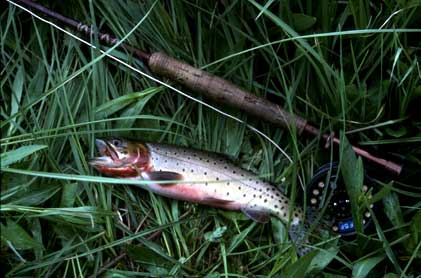 |
| Cutthroat trout are available in many mountain lakes and creeks. |
Continental Divide
Another location for anglers wanting to hook up with a greenback cutthroat is Rocky Mountain National Park. Fern and Odessa Lakes both have the rare natives. Both lakes are on the headwaters of the Big Thompson. Shortest access is from Bear Lake, a hike of about four miles on the Fern Lake Trail.
Those preferring streams should try the Colorado River in the Kawuneeche Valley. It's easy to reach from the Grand Lake Entrance along U.S. 34. Anglers will find relatively little pressure on this small headwater stream that has brook, brown, cutthroat, and rainbow trout. It's restricted to flies and lures, C&R.
The Rollins Pass area along the Divide west of Denver has lots of high lakes to try your luck close to home. Much of the region has been officially roadless for more than a dozen years so access is by foot. South Boulder Creek heads here. It has fair fishing for small rainbows and cutts and it's easy to reach. CR 16 follows the stream and it's open in the national forest. Private land is well marked.
Forest Road 149 east of Rollinsville offers access to the two Forest Lakes. A quarter-mile hike gets anglers to either lake, both of which have brookies.
Anglers seeking cutthroats can hike a mile further south cross-country to the Arapahoe Lakes, both at timberline. In the same area below the Divide's east side lie Heart, Iceberg, and Crater Lakes. Going cross-country on the talus slopes from the Rollins Pass Road can be tough walking. At East Portal, Trail 900 accesses the lakes by a four-mile hike that climbs 1700 feet.
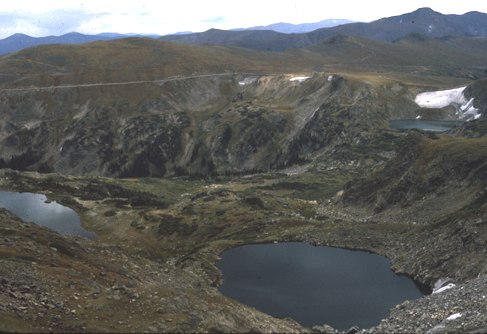 |
| The Rollins Pass area west of Denver has dozens of high lakes for a day trip |
Northwest
The Mount Zirkel WA north of Steamboat Springs is loaded with lakes along the Divide. The Mad Creek and Elk River drainages have enough lakes to keep the backpacking angler busy all summer. Typically the fish, especially the brookies, don't get real large but they are eager to take a fly or lure. They're also good for dinner.
The Flat Tops WA has too many lakes and streams to list. County Road 12 heads south from CR 8 following Marvine Creek. A couple of miles are open near Marvine Campground, with more public access in the wilderness. Backpackers can take Trail 1823 to fish the creek and both Marvine lakes, a six mile trip. The lakes and stream have brook and cutthroat trout. Pine Isle and Ruby Lakes are nearby but difficult to find.
The best known lake in the region is Trappers at the end of FR 205. Other lakes for a day hike from the road are Skinny Fish, McGinnis, Little Trappers, Big Fish, Mirror, and Anderson Lakes.
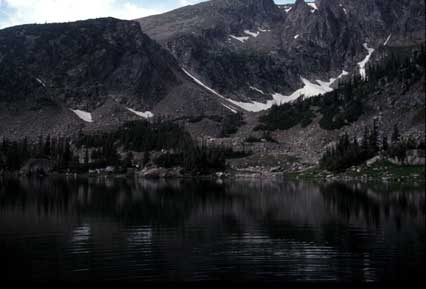 |
| High-country lakes offer great scenery as well as fine fishing opportunities |
Southwest
Colorado's largest wilderness, the Weminuche, can occupy an angler for years, while never fishing the same water twice. A good place to begin might be in the Needle Mountains. Backpackers can ride the narrow gauge railroad between Durango and Silverton and be dropped off and picked up at Needleton.
Trail 504 follows Needle Creek, climbing into Chicago Basin. The trails gets lots of traffic but nearby areas are little used. The nearest lakes are Webb, Pear, and Emerald, two miles along 504. Head south a mile to Webb. Pear and Emerald are another mile cross country. Depending on time available for a backpack trip, continue along 504 through the Needle Mountains. Two dozen or so lakes are scattered around the region. The lakes have brook, cutthroat, and rainbow trout. Some were stocked by CDOW with Snake River cutts. They do well and usually grow larger than other species. Some of the lakes that have brookies hold naturally reproducing populations.
Copyright © 2000-2012 by Al Marlowe. No reproduction, linking, or copying without permission.
Resources/Other Info:
 Al
has written a book, "Fly Fishing the Flat Tops". You can order a paperback copy through
Barnes and Noble, or
Amazon. This book
gives descriptions and locations of almost every fishing opportunity in the Flat Tops.
Al
has written a book, "Fly Fishing the Flat Tops". You can order a paperback copy through
Barnes and Noble, or
Amazon. This book
gives descriptions and locations of almost every fishing opportunity in the Flat Tops.