


Elevenmile Canyon
Submitted by Michele White (Murray), Tumbling Trout Outfitters
For reason’s of denial, I suppose, I’ve lived in the vicinity of this fishing venue for five years and never ventured up the Eleven-Mile Canyon. Instead, I fantasize about tail-waters far from my house (Pueblo Reservoir, San Juan, Bighorn, etc.) and wonder when I will be able to go dry fly fishing again. Last weekend, Doug’s brother, Dale, invited us to join him on the South Platte River above Lake George in the Eleven-Mile Canyon. Dale is brand spankin’ new to fly fishing and is quite taken by the sport.
I was surprised to see the river free of ice, though the road can be harrowing with ice in narrow stretches of shaded canyon (the road used to be a narrow-gauge train trestle). Doug told me he hasn’t fished there in years because the water level is usually too high and fast for his taste, that the newly exposed holes and meanders are usually unwadeable chutes for kayaking during normal water levels. Also, the river didn’t used to be known for any special fishing. That was ten years ago. Since then, the stretch below the dam to the Springer Gulch Bridge has been protected by strict regulations and has become known for great fly fishing – especially now that the water level is lower. I’d say the South Platte in this canyon is running similar to the Arkansas right now, with one exception: the trout are not freaked out, as they are in the Arkansas.
There were many places we could see from the road, where beautiful deep holes swept against tall walls of protective granite. Dale pointed out what he called, “honey holes”, where he can predictably catch loads of rainbows by nymphing with white midge “miracle” nymphs, or red midge, “Bighorn Specials” trailing behind bead-head pheasant tail flies. We selected a place to park on a cliff-like bank, overlooking a bend where the river made a wide, long pool between steep chutes of riffles and boulders. The three of us would be able to split up, one going upstream, one going down, and the third person fishing in the flat, lake-like bend where we could see schools of trout rising.
Dale opened his fly box and I was astonished to see immaculately aligned rows of nymph flies organized in descending sizes. Doug’s flies somehow arrange themselves into one large clump, like a hair-wad in a hairbrush. I dread opening his fly box because they spill out all over kingdom come. My box is semi-organized. Dale began placing a selection of his flies into my opened box.
“Hey, I don’t want to be taking all these flies. They look like expensive ones,” I argued.
“Oh, I tied these. I’ve got lots,” Dale replied. At this comment, Doug and I both hovered over his box of flies to look at them in more detail. Dale has been tying flies less than a couple of months. His flies were perfect! Very symmetric and well-formed. They were of professional quality. We were humbled.
As we dressed up, we analyzed the rising fish below us and decided that whoever was going to angle them would have to hike a bit upstream and then sneak up on the pod from the far side, being careful to hide and fish on their knees (because the water was so clear and shallow). This type of stealth fishing doesn’t appeal to Doug. He would rather get a lot of fish in a short period of time, than spend a lot of time trying to fool a particularly picky trout into taking his fly. On the other hand, I would rather stay in one place, sneak up on a trout and take my time trying assorted fly patterns and methods of casting until wrangling the wily beast. (Dale had a “honey hole” to attend.) So, we split up.
It was a fine, sunny day and I was able to fish without a jacket for a while. I watched the rising trout from the cover of bushes about 20’ away. The bank between my cover and the river was open and free of any obstacles to hide behind. Also, the bank dipped down to the water on a gentle slope, so all the fish within a mile could see me on my approach. I saw that they were rising consistently all over the place, in both shallow and deep water. I saw large, dark mayflies, and midges it he air. The trout were gently sipping, like they do when the mayflies are skimming around on the surface, rather than leaping like they do when the larvae is making a dash for the surface, or shedding its wings.
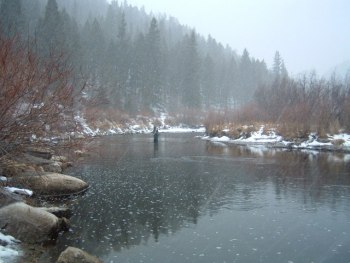 |
| Rings of fish rising in the foreground. Blurs of snowflakes in the air. Foam dots on the water. A great day to be flyfishing Elevenmile..... |
I performed my belly-stalking and started casting with my smallest, dark mayfly. I worked through all my colors and sizes and eventually found myself standing on a large boulder overlooking the lot of them, thwacking the water with everything I had. What I eventually came up with is a #16 B.W.O. with at least 18” of 6X tippet. The most significant element was to achieve a drag-free drift for at least 5 seconds. The fish were not at all spooky and were only slightly picky, as they at least bumped my assorted flies. I noticed that the current was not at all uniform. Underwater sand bars, deposited parallel made for multiple chutes of slicker, fast water bound by slow water. The result being narrow channels of slow water that the trout preferred.
The problem for casting was that the slow water would hold the fly while the faster water on either side quickly pulled the line. Mending made the trout suspicious. I had to cast fast and up in the air to make the tippet stretch out, then begin to recoil as it fell on the water. This made the tippet land in a zig-zag of spaghetti, which gave some time for the fly to sit on the water before the line pulled all the tippet taught. Then, I began catching fish – bright red rainbows about 10”-14” long.
Eventually, I moved upstream to a riffle and nymphed there for a while. All of the sudden, the wind picked up and black clouds popped over the rim of the canyon. I was standing on an overhanging ice cornice, when it broke and I fell in up to my chest. Beware the overhanging ice of this canyon! I could feel the water trying to find its way over the top of my waders, though the waist band was tight. I saved myself and went back to the truck because I was frozen to the bone. My comrades saw me and also returned to the truck. They filled me with hot chocolate and dried my sleeves and gloves on the heater. Then, we moved on to see the rest of the river upstream.
We ended up parking about one mile below the dam, where the river is shallow and meanders through low-lying, grassy fields. Doug ad Dale moved off to fish the faster water, as they have a faster water / bigger fish theory. I simple walked to the bank next to the truck and greeted the pools of rising fish. I could see them, they could see me. I put my #16 B.W.O. on a zig-zag cast about 5 feet upstream and started to catch the beasts again. I didn’t even have to enter the water, except to release them.
It started to snow. Then, it started to REALLY snow. My hands had turned into meat-claws. After I decided it was taking me too long to release a fish because I couldn’t operate the hemostats anymore, I decided to stop fishing. I ended up napping in the truck while Doug and Dale continued fishing. I dreamt of my hot tub calling my name.
D & D didn’t stop until the snow threatened to cut off our escape. I took some photos, as these two brothers looked so durn tough. By the time we left, a blizzard was raging. However, the fishing was so sweet, and provided such a lovely surprise in that I felt like a fantasy had come true. Here it is mid-February, and I am dry fly fishing a wonderful river hardly 20 miles from my house that had been hidden in a canyon I hardly knew existed. Things like this truly make me appreciate living in Colorado.
Resources - Plan your trips:
 Buy South Platte Downloadable Digital Fishing Maps
Click here for info or to purchase.
Buy South Platte Downloadable Digital Fishing Maps
Click here for info or to purchase.
 Buy
an ebook '50 Colorado Tailwaters' - includes the Elevenmile tailwater
Buy
an ebook '50 Colorado Tailwaters' - includes the Elevenmile tailwater
All text and photos copyright Michele White (Murray), Tumbling Trout Outfitters