



Counting Fish
by Karen Christopherson
Have you ever wondered how fish numbers are calculated, as when someone says, "There are 1000 trout per mile in this stream"? Do you think the wildlife people stand on bridges wearing polarized glasses, try to spot fish, and count, "1 trout, 2 trout, 3 trout" while someone tabulates their yelled counts on a pad?
There are actually several methods for "counting fish" or doing fish population surveys. One of the methods used on creeks and rivers is electrofishing.
In October, 2000, several member of Evergreen Trout Unlimited (including the author) assisted the Colorado Division of Wildlife with the fish count on Bear Creek, our local water. We helped with the sampling of three reaches, which had been sampled seven times previously since 1988.
The process of electrofishing is very interesting and involves several steps. Basically, a portable generator is used to provide a pulsed, DC current through an insulated wire which is several hundred feet long. The generator produces about 250 volts, causing a current of about 1.5 amps to be transmitted. This wire is placed in the river, with the negative ends of the wire (cathode) at the upstream end. All of the surveyors proceed downstream to the start of the reach. There are three or four people with electrodes (a probe which is placed in the water and provides the positive end of the current, the anode) - these people will be walking in a line across the stream and placed about five to 10 feet apart. Each probe person also carries a large dip net on about a six-foot pole. The electrodes are connected together by insulated wire, which in turn is connected to a wire running back to the generator.
Standing behind the lead line of probe-holders are backup samplers also carrying nets. Their job is to catch the fish that escape the front line, and also to pass fish from the front to the rear. At the rear of the group is the fish holding tank, which is a flooded net in a sturdy surround that can be dragged upriver.
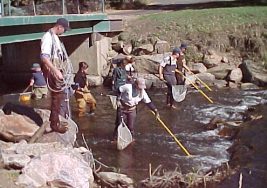 |
| The crew of surveyors |
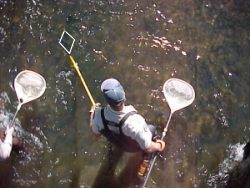 |
| Electrode probe, placed in water and held in left hand and net in the right hand (probe has been outlined for visualization) |
The process starts with the probeholders sweeping their electrodes back and forth through the water in front of them. The current in the water will affect fish from one to six feet away from the probe, with smaller fish affected at closer range. As the current reaches the fish, electrotaxis effects the nervous system, and thus the muscular system, causing the fish to be attracted towards the positive probe, slightly stunned. The samplers have to be very quick in their wading boots to catch the fish. The fish are caught in the net and passed back to the holding tank.
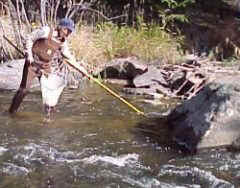 |
| Searching for fish in a nice pool |
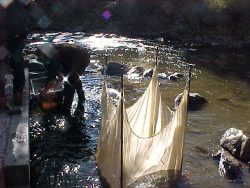 |
| The live net placed in the stream (used for holding the fish before counting) |
The group proceeds upstream to the end of the reach, just downstream from the negative end of the current wire. If the holding tank is full, these fish will be placed in a live net, stationed about midway through the reach. Else, at the end of the reach, all of the fish are placed in the live net.
One person immediately starts to measure the fish. Each fish is singularly measured in millimeters, weighed in grams, and then placed back in the river. Another person tabulates these measurements and also records the species of fish. On this day of sampling in Bear Creek, four species were sampled - brown trout, rainbow trout, longnose daces, and longnose suckers.
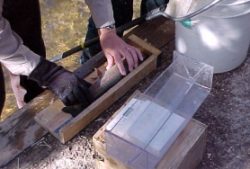 |
| Measuring a rainbow |
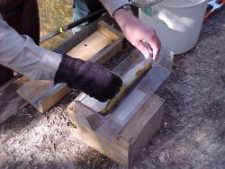 |
| Weighing a brown trout |
While the measuring and weighing is started, the rest of the group return downstream to do a second pass of sampling. The procedure is exactly the same as before; but with far less fish being found. To be successful, an electrofishing survey should sample about 65% of the estimated population on the first pass.
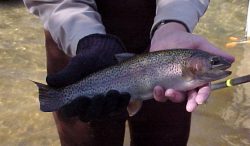 |
| One of the fine rainbows sampled |
After the sampling is done, and the second pass fish have been counted, the crew moves on to the next sampling area. The tabulated data of fish species, length and weight will be compiled in the office. Computer programs and statistical analyses (specifically Seber-LeCren estimations) are used to determine the probable distribution of species and size of fish in the sampled reach. Several statistical estimates can be determined such as number per acre, number per mile, pounds per acre for specific species or (for example) trout population as a whole.
These numbers acquired from electrofishing are useful for numerous reasons. Obviously, we flyfishermen and women like to know how many trout are in a particular stream. Fish count information is used by wildlife divisions to label rivers as "Gold Medal", "Blue Ribbon", and others. Electrofishing data are also used in environmental assessments of rivers, in determination of regulation changes, in stocking analysis, and many other ways by wildlife and fishery groups.